Related People
Scott Hudson, Lea Albaugh, Franchesca (Franky) Spektor, Shivani Kapania, Minjung Park, Jodi Forlizzi, Sarah Fox, Ken Holstein, John Zimmerman, Kyzyl Monteiro, Seyun Kim, Haiyi Zhu, Motahhare Eslami

CMU at DIS 2026

The Association of Computing Machinery (ACM) Conference on Designing Interactive Systems (DIS) was held June 13-17, 2026, in Singapore.
With the theme "Beyond Interaction," the interdisciplinary conference encouraged attendees to rethink the boundaries of interaction and reexamine what it means to design interactive systems for complex ecosystems. Research in this area can focus on design theory, methods and technologies, as well as cultural, economic and political impacts.
Carnegie Mellon University researchers received one Best Paper Award, one Honorable Mention Award, and had several other works accepted. Explore the papers with CMU contributing authors and their abstracts below, or in the online program.
🏆 Best Paper Award
Knit Joinery: Incorporating Multifunctional Materials with Single-bed Machine Knitting
Yi-Chin Lee, Vernelle A. A. Noel, Scott E Hudson, James McCann, Lea Albaugh
Domestic manual knitting machines are widely used among hobbyists and for small-scale production. However, they are often seen as less capable or niche, and their potential for integration with other materials and machinery has remained relatively unexplored in the HCI community. Knit Joinery proposes an approach that uses knitting as a joinery method to interact with other digital fabrication tools, including laser cutters, 3D printers and CNC knife cutters, becoming part of a makerspace ecosystem. The goal of this paper is to broaden the use of manual knitting machines and position them as a fabrication tool rather than devices solely for producing soft materials. We present examples demonstrating how a manual knitting machine can integrate with laser cutting and 3D printing machines, soft-circuit fabrication, and creative reuse.
🏅Honorable Mention Award
Designing Worker-Led Documentation Practices: How Unionized Cleaners Articulate Harm Beyond Reporting
Franchesca Spektor, Shivani Kapania, Minjung Park, Olivia Terry, Jodi Forlizzi, Sarah E Fox
Formal regulation designed to protect workers is often opaque, with narrow definitions of injury. This means that even when workers report harm, regulators fail to intervene on cumulative, chronic, and collective experiences. Through interviews and co-design workshops with unionized cleaning workers, we explore alternative forms of documentation that support collective action rather than institutional proof. Our study illuminates four interlocking worker-led documentation practices: (1) Surfacing experiences of working conditions, (2) Collectively making sense of existing reporting avenues, (3) Negotiating with management and publics, and (4) Building trust and solidarity within the union. For each of these practices, we offer concrete design concepts developed in collaboration with workers. Finally, we contribute conceptual knowledge on how engaging in the process of documentation functions as an engine of solidarity-building, a prerequisite for addressing workplace harms beyond disparate data points.
AI Design Sprints: Facilitating AI Innovation within Cross-functional Industry Teams
Nur Yildirim, Kayur Patel, Florian Dusch, Dennis Knopf, Melike Yusufoglu, Dominik Schuler, Kenneth Holstein, Jodi Forlizzi, James McCann, John Zimmerman
Artificial intelligence (AI) technologies offer tremendous potential for product and service innovation, yet finding good use cases remains challenging. Currently, AI projects largely fail due to breakdowns in early stage ideation and problem formulation. Drawing on HCI research that used AI capabilities and examples to facilitate AI concept ideation, this paper investigates how these approaches might be operationalized in industry settings. We collaborated with cross-functional industry teams in insurance, accounting, and consultancy. We conducted a series of AI Design Sprints, where innovators simultaneously consider AI capabilities and human needs. All teams perceived the ideation method highly valuable both for rapidly exploring use cases and building AI literacy within teams. We detail our process, the challenges, and artifacts that proved effective. We share insights on how AI projects get initiated, and how innovation teams identify use cases. Reflecting on these case studies, we discuss opportunities for improving early stage AI innovation.
Elemental Alchemist: A Generative Interface for Semantic Control of Particle Systems Across Dynamic Levels of Abstraction
Kyzyl Monteiro, Evan Atherton, George Fitzmaurice, Qian Zhou
Editing particle-system visual effects (VFX) is vital for digital storytelling, but achieving controllable, art-directable results remains challenging due to their multi-dimensional nature. Given a large collection of parameters, users must find the ones relevant to their creative goals–a task that requires a systematic understanding of the particle system and how parameters map to high-level intents, such as making a fire look angry. Elemental Alchemist is a generative interface that transforms user intent into contextualized controls for semantic editing of particle systems. The system introduces two components: a contextual brush palette that generates tools based on scene context, and a generative control panel that surfaces relevant technical parameters and abstracts them to generate mid-level semantic attributes and high-level conceptual controls. An evaluation with 10 novice and 5 expert VFX practitioners shows the system supported users in translating high-level creative goals into particle system parameters.
StreetDesignAI: Broadening Designer Perspectives Through Multi-Persona Evaluation of Cycling Infrastructure
Ziyi Wang, Yilong Dai, DUANYA LYU, Mateo Nader, Sihan Chen, Wanghao Ye, Zijian Ding, Xiang Yan
Designing cycling infrastructure requires balancing the competing needs of diverse user groups, yet designers often struggle to anticipate how different cyclists experience the same street environment. We investigate how persona-based evaluation can support cycling infrastructure design by making experiential conflicts explicit during the design process. Informed by a formative study with 12 domain experts and crowdsourced bikeability assessments from 427 cyclists, we present StreetDesignAI, an interactive system that enables designers to (1) ground evaluation in real street context through imagery and map data, (2) receive parallel feedback from simulated cyclist personas spanning confident to cautious users, and (3) iteratively modify designs while the system surfaces conflicts across perspectives. A within-subjects study with 26 transportation professionals comparing StreetDesignAI against a general-purpose AI chatbot demonstrates that structured multi-perspective feedback significantly Broaden designers’ understanding of various cyclists’ perspectives, ability to identify diverse persona needs, and confidence in translating those needs into design decisions. Participants also reported significantly higher overall satisfaction and stronger intention to use the system in professional practice. Qualitative findings further illuminate how explicit conflict surfacing transforms design exploration from single-perspective optimization toward deliberate trade-off reasoning. We discuss implications for AI-assisted tools that scaffold persona-aware design through disagreement as an interaction primitive.
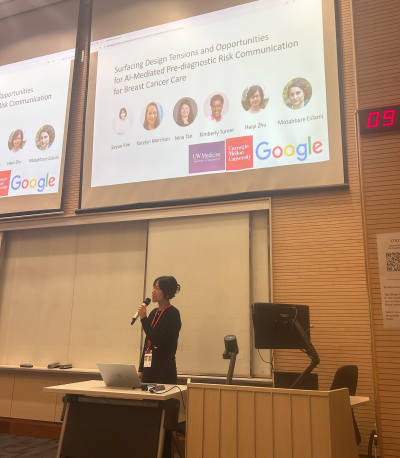
Surfacing Design Tensions and Opportunities for AI-Mediated Pre-diagnostic Risk Communication for Breast Cancer Care
Seyun Kim, Katelyn Morrison, Nina Tan, Kimberly Turner, Haiyi Zhu, Motahhare Eslami
AI development for healthcare aims to enhance medical decision-making through risk evaluation. Scholars have focused on improving the accuracy of Breast Cancer AI Risk Assessment Tools (BC-AIRAT), yet these tools remain underutilized in clinical practices. This provides an opportunity to explore how these tools are used and how they may support risk communications. We conducted a three-phase study, with clinicians and patients, in the context of the United States healthcare system, including formative interviews that surface the challenges of BC-AIRAT practices, design probe re-purposing BC-AIRAT as supporting risk communications, and design probe-driven interviews with diverse stakeholders. Our findings surface the gap and opportunity for designing AI-mediated risk communication tool, highlighting the participants’ reflections on AI for managing risk assessment workflows, mediating fragmented breast health guidelines, and delivering information to patients for proactive decision making. We conclude with design implications for using AI as a mediator in breast cancer risk communication.
This generative AI meets responsible AI work was supported by a Google Research Scholar Award.
Who Gets Left Out of Digital Banking in Later Life? Barriers and Opportunities in Hong Kong's Silver Population
Clarence Chi San Cheung, Jianan Liu, Lulin Chen, Qiongyan Chen, Luchen Li, Pan Hui, Lik-Hang Lee, Mingming Fan
As digital banking increasingly replaces face-to-face financial services, older adults face growing challenges in navigating self-service and mobile platforms. This issue is particularly salient in Hong Kong, where a highly digitalized yet fragmented multi-channel banking ecosystem combines branches, ATMs, mobile apps, and phone banking. While prior research has identified general barriers such as usability and trust, less is known about how banking practices, challenges, and support needs differ across stages of later life. We address this gap through a mixed-methods study in Hong Kong, combining an in-person survey with 151 adults aged 60+ and semi-structured interviews with older adults and frontline bank staff. Participants were grouped into young-old (60–69), old-old (70–79), and oldest-old (80+) cohorts. Our findings reveal clear age-related patterns: young-old adults actively use ATMs and digital banking but report strong psychological concerns; old-old adults rely on hybrid channel use and face increasing knowledge-related barriers; and oldest-old adults depend primarily on physical branches due to compounded physical and cognitive limitations. We conclude with age-specific design implications for more inclusive digital banking systems.
Research Areas